






 Trap
 Counter
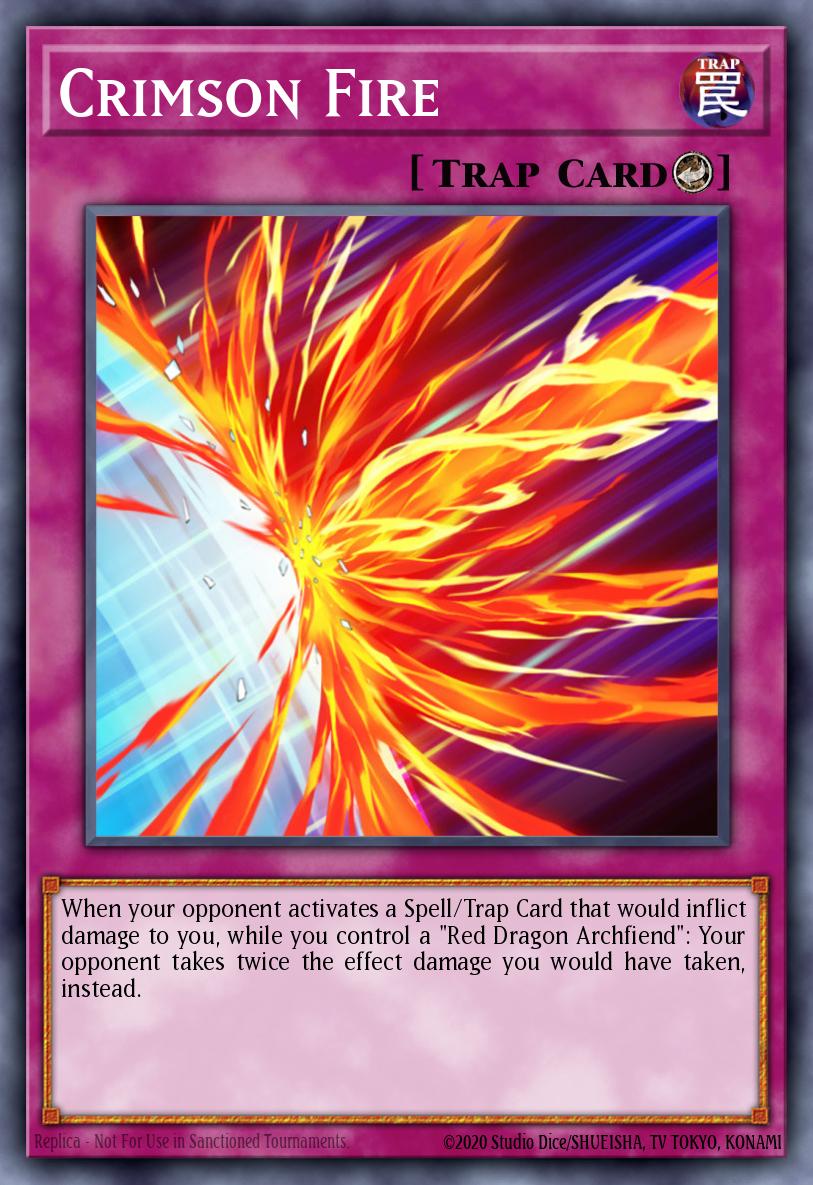
Crimson Fire
Archetype:
Archfiend
View:
4379
When your opponent activates a Spell/Trap Card that would inflict damage to you, while you control a "Red Dragon Archfiend": Your opponent takes twice the effect damage you would have taken, instead.
Crimson Fire — Power Evaluation
Final Score: 44 ± 8 · Confidence: Medium
- Intrinsic: 42 · Deck: 45 · Meta: provisional
- Primary role: Negation/Interaction · Secondary: Utility
Why it scores here
Crimson Fire is a conditional Trap that only punishes Spell/Trap damage, doubling the effect damage the opponent would have dealt to you, and only while you control a Red Dragon Archfiend. It converts nothing into board, cards, or negation, so combo and resource scores stay low. It earns a middling score from reliable access in a dense Red Dragon Archfiend shell (54 of 54 sampled decks, average 2.02 copies), not from its ATK or popularity, which earn nothing here.
Axis scores
| Axis | Score | Evidence |
|---|---|---|
| Accessibility | 55 | Set Trap in 54 of 54 sampled decks at about 2 copies, but it is only live while a Red Dragon Archfiend is on the field (partner present in 92.6% of decks). (observed) |
| Combo & Conversion | 20 | No combo boards are recorded and the text builds no board or card advantage by itself, so this is text-only inference. (inferred) |
| Resource Economy | 25 | No draw, search, recursion, or card advantage; the effect is a damage multiplier against the opponent's damage-dealing Spell/Trap cards. (verified) |
| Effect & Interaction | 40 | Punishes damage-based Spell/Trap activations rather than negating them, so it is narrow and situational. (verified) |
| Material Utility | 5 | A Trap card cannot be used as Link, Synchro, Xyz, or Fusion material, so the score is near the floor. (verified) |
| Resilience & Flexibility | 35 | Depends on one live Red Dragon Archfiend and on the Trap surviving the opponent's removal and interaction. (inferred) |
| Deck-Building Efficiency | 55 | Costs roughly 2 slots in a shell that already runs the required monsters, with no garnet or lock restriction; the cost is in the narrow condition. (observed) |
Calculation
Weight profile: 0.7 Negation/Interaction + 0.3 Utility. Intrinsic ≈ 42, Deck ≈ 45, Meta = provisional. Modifiers: none. Final formula: 0.40*Intrinsic + 0.60*Deck
Strengths
- Clean, unambiguous damage-doubling text with a single condition
- Live in 54 of 54 sampled decks, the Red Dragon Archfiend shell's core interaction
- Low-cost trap slot with no garnet or lock restriction
Weaknesses
- Conditional on controlling a Red Dragon Archfiend, so it is dead in many spots
- Punishes only Spell/Trap damage, not monster damage or other interaction
- Does not negate, draw, search, or build board
Counters / choke points
- Removal or banishment of the Red Dragon Archfiend
- Opponent lines that deal no Spell/Trap damage
- Opponent's negation or removal of the Trap itself
Best use
Negation/Interaction. Decks: Red Dragon Archfiend shell, Resonator (Crimson Resonator) shell. Suggested copies: 2.
Evidence & gaps
- Verified: Card text: opponent takes twice the effect damage from their Spell/Trap activations while you control a Red Dragon Archfiend; Card type: Trap Card, so it cannot be material; 54 of 54 sampled decks run it in main deck, average 2.02 copies
- Observed: Scarlight Red Dragon Archfiend co-occurs in 100% of decks; Red Dragon Archfiend in 92.6%; Spread across 10 archetypes, led by Resonator (27.8%) and Archfiend (22.2%); Gameplay type 7 accounts for 88.9% of decks
- Inferred: Real role is punishing Spell/Trap damage, not negation; Value depends on the Red Dragon Archfiend engine rather than generic use
- Data gaps: no combos supplied — combo conversion is text-only inference no guides supplied no banlist token — assumed 3 copies (unlimited) no usage statistics (StatisticsCard) — archetype inclusion % inferred from deck sample only